famous women designers
Famous Women Designers: 10 Icons to Know in 2026
Discover 10 famous women designers from Chanel to Prada, their signature styles, iconic pieces, and styling ideas for 2026 inspiration.
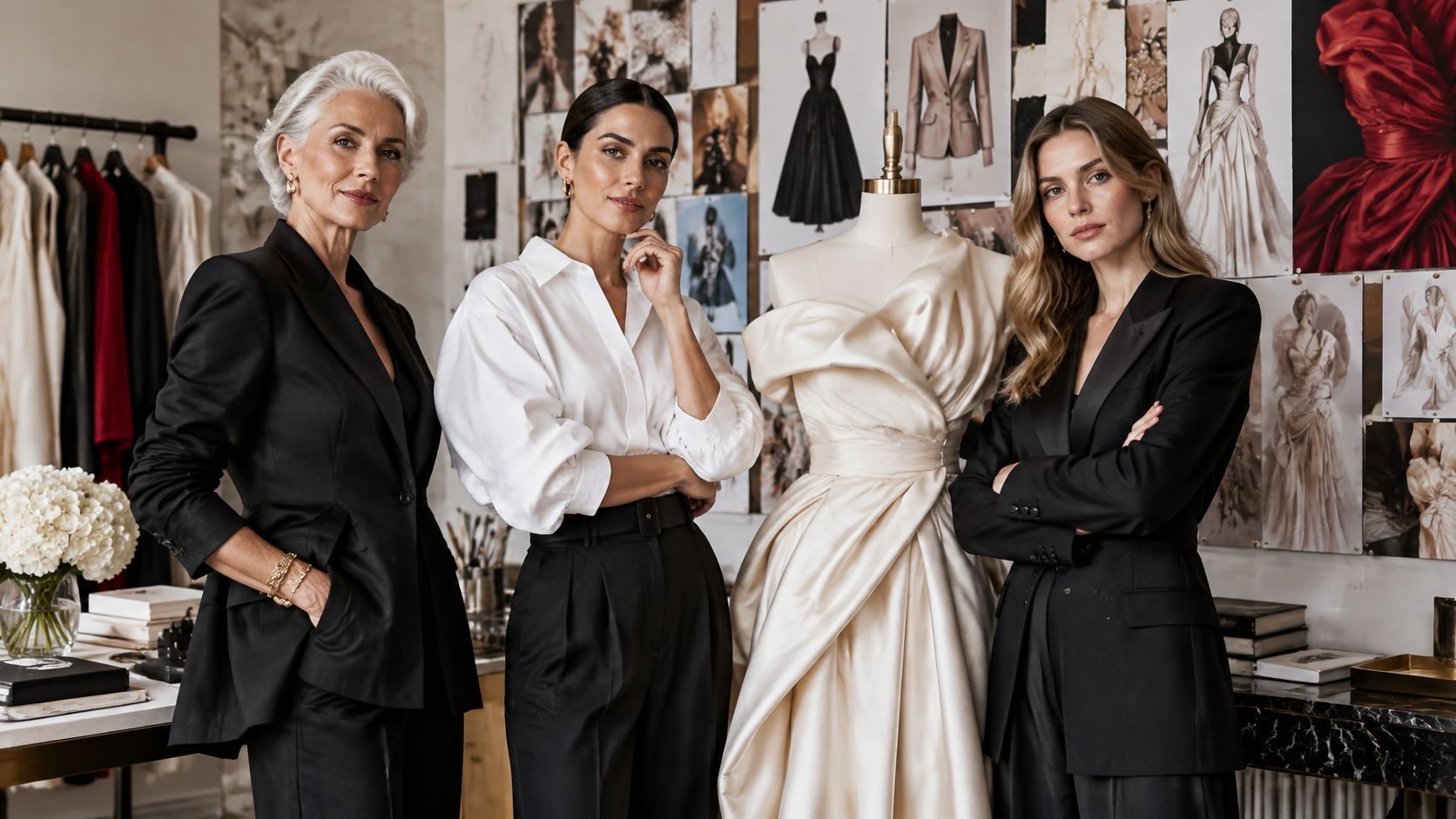
A buyer once asked why a black jersey wrap still outsold every printed "new" dress in the same drop. The answer wasn't nostalgia. It was a waist tie shoppers already knew how to wear to work and to dinner.
Famous women designers who changed closets did it with a move you can see in one frame. From the little black dress to deconstruction and clothes that refuse leather, these ten signatures still tell a team what to shoot. This isn't a hall of fame. Each section ties a technique to an outfit you can rebuild for an editorial or a collection.
Last season's miss is common. Twelve dresses, one winner, and the winner was the silhouette people didn't need a caption to understand. Print lost to construction. Use that test on the names below.
Credit is a separate problem from talent. Women spent about three times as much as men on apparel, about $159 billion in U.S. sales in 2017, yet they accounted for only 40.2% of the 371 designers leading 313 brands in the McKinsey, Glamour, and CFDA Glass Runway study. That work surveyed 535 industry professionals and interviewed 25 U.S. fashion professionals, so it's a planning benchmark, not a celebrity list. Fame often tracks market access. Keep the designer's name on the garment file, the prompt, and the published frame so a look doesn't float free of its author.
Table of Contents
- 1. Coco Chanel and the Little Black Dress
- 2. Madeleine Vionnet and the Bias Cut
- 3. Elsa Schiaparelli and Shocking Pink
- 4. Mary Quant and the Miniskirt
- 5. Vivienne Westwood and Punk Tailoring
- 6. Diane von Furstenberg and the Wrap Dress
- 7. Donna Karan and Seven Easy Pieces
- 8. Rei Kawakubo and Deconstruction
- 9. Stella McCartney and Sustainable Luxury
- 10. Miuccia Prada and Nylon Luxury
- 10 Famous Women Designers: Signature Innovations Comparison
- Try These Iconic Styles in Your Next Shoot
1. Coco Chanel and the Little Black Dress
Gabrielle Chanel treated a wardrobe as parts, not one costume. Corsets lost. A simple black dress, a collarless tweed jacket with braid, and a straight skirt could move from day to evening if only the accessories changed. American Vogue's 1926 sketch of a black crepe dress made the little black dress public. The 2.55, quilted leather and a chain strap from 1955, ran the same idea through a bag.
The mix only reads when the camera stops changing.
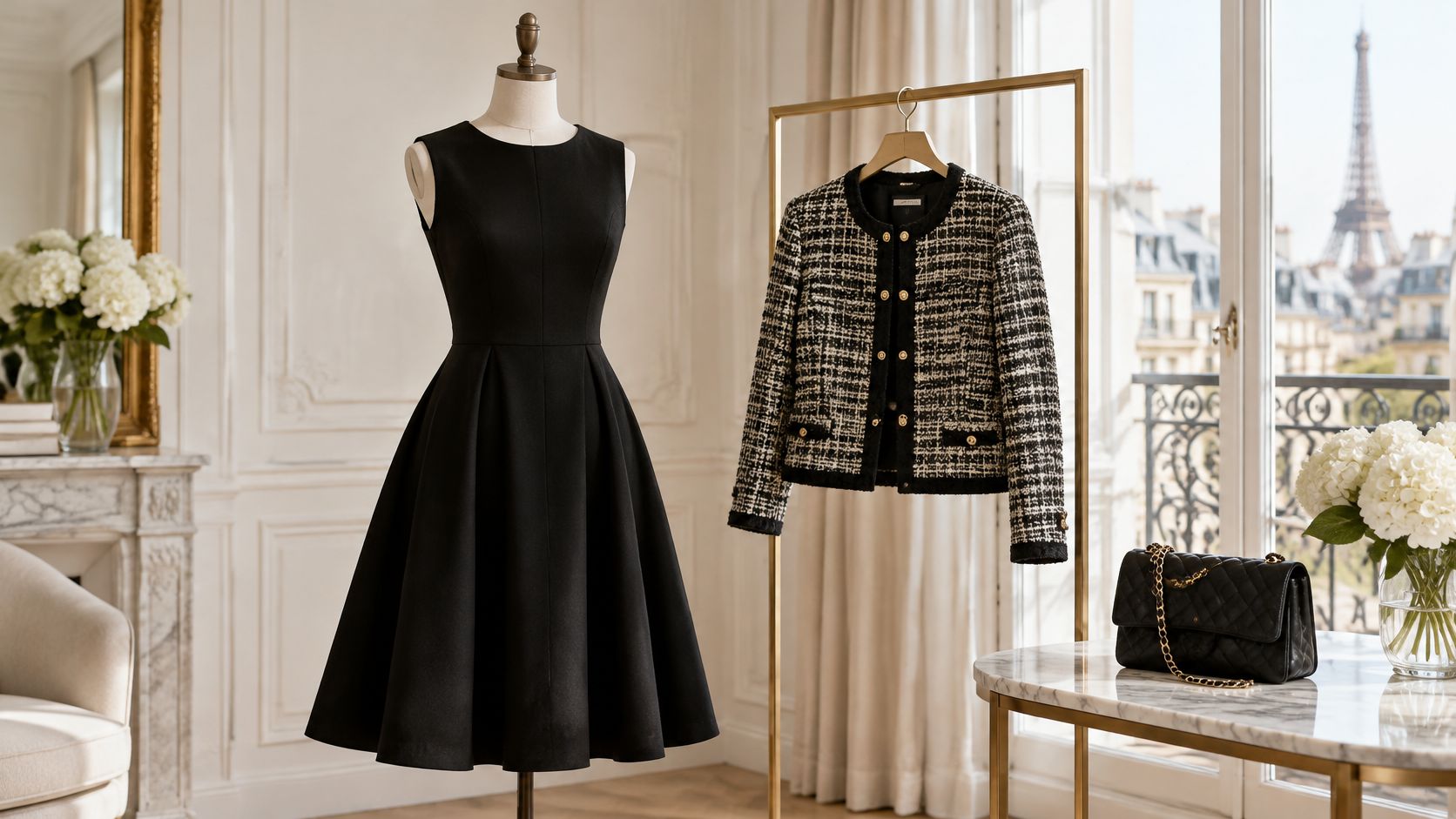
What to shoot this week
Start with three to five cores, then change the bag, shoe, or scarf. Shoot them like a tight clothing product photo set, with the base garment obvious in every crop.
- One base, three finishes: Lock pose and light so shoppers see the mix, not a new campaign.
- Accessory swap: The dress stays. Jewelry and the chain strap do the selling.
- Shared shoulder line: If the jacket fights the dress, you don't have a capsule.
Practical rule: If the jacket disappears when you change the shoe, the story is too busy.
A twelve-piece "capsule" with no shared color fails. Chanel's system works because the pieces repeat more than they argue.
2. Madeleine Vionnet and the Bias Cut
Madeleine Vionnet cut cloth on the diagonal so it clung and swung instead of standing up like armor. Through the 1920s and 1930s she dropped corsets for Greek-like drape, often on her own forms, in silk crepe and jersey. John Galliano and Azzedine Alaïa later chased that cling. The slip dress in a current catalog is the commercial leftover.
The drape only reads if the cloth is allowed to fall.
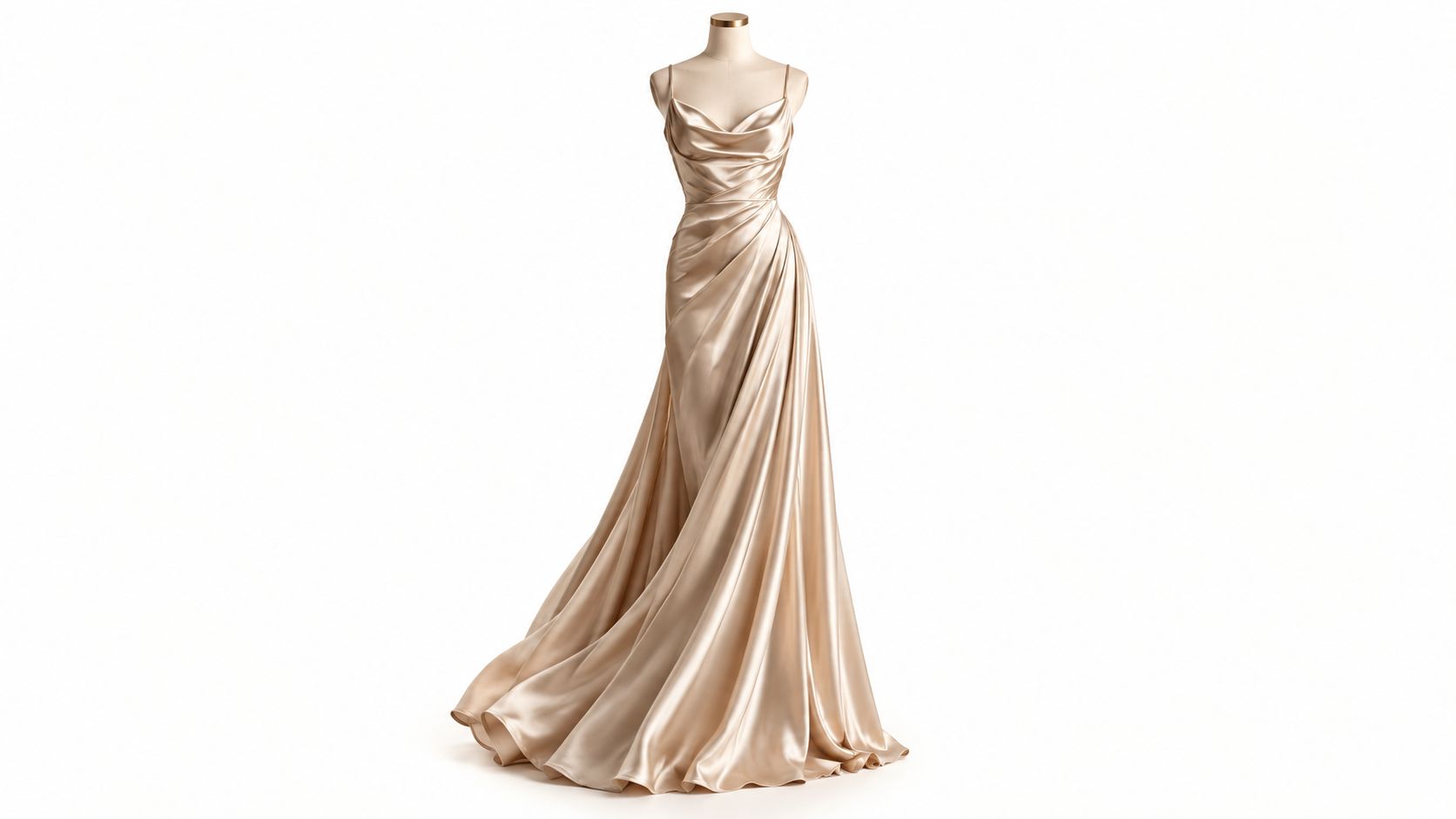
A bias gown on a stiff A-pose looks like a sack. Shift one hip so the diagonal crosses the torso, and leave the back seam visible. Buyers judge movement there, not in a flat lay.
Prompt you can reuse
"Champagne bias slip, soft side light, one hip shifted, hem pooling, no jewelry."
A short drape study shows why a frozen product shot lies about fit.
- Name the cloth: Crepe, jersey, and satin don't swing the same distance.
- One walking frame: Park it beside the hero still.
- Stretch in the file: Otherwise a fluid dress gets rendered as a column.
If you can't see the pull from shoulder to hem, reshoot before you write the fit copy.
3. Elsa Schiaparelli and Shocking Pink
Elsa Schiaparelli treated clothes as pictures you could wear. The 1928 trompe l'oeil sweater faked a bow in knit alone, with no extra fabric. The 1937 lobster dress, made with Salvador Dalí and later worn by Wallis Simpson, put a seafood motif on a pale gown. She also pulled the zipper out of hiding and made it a design line. Shocking pink did the lobster's job in color. It refused to behave like trim.
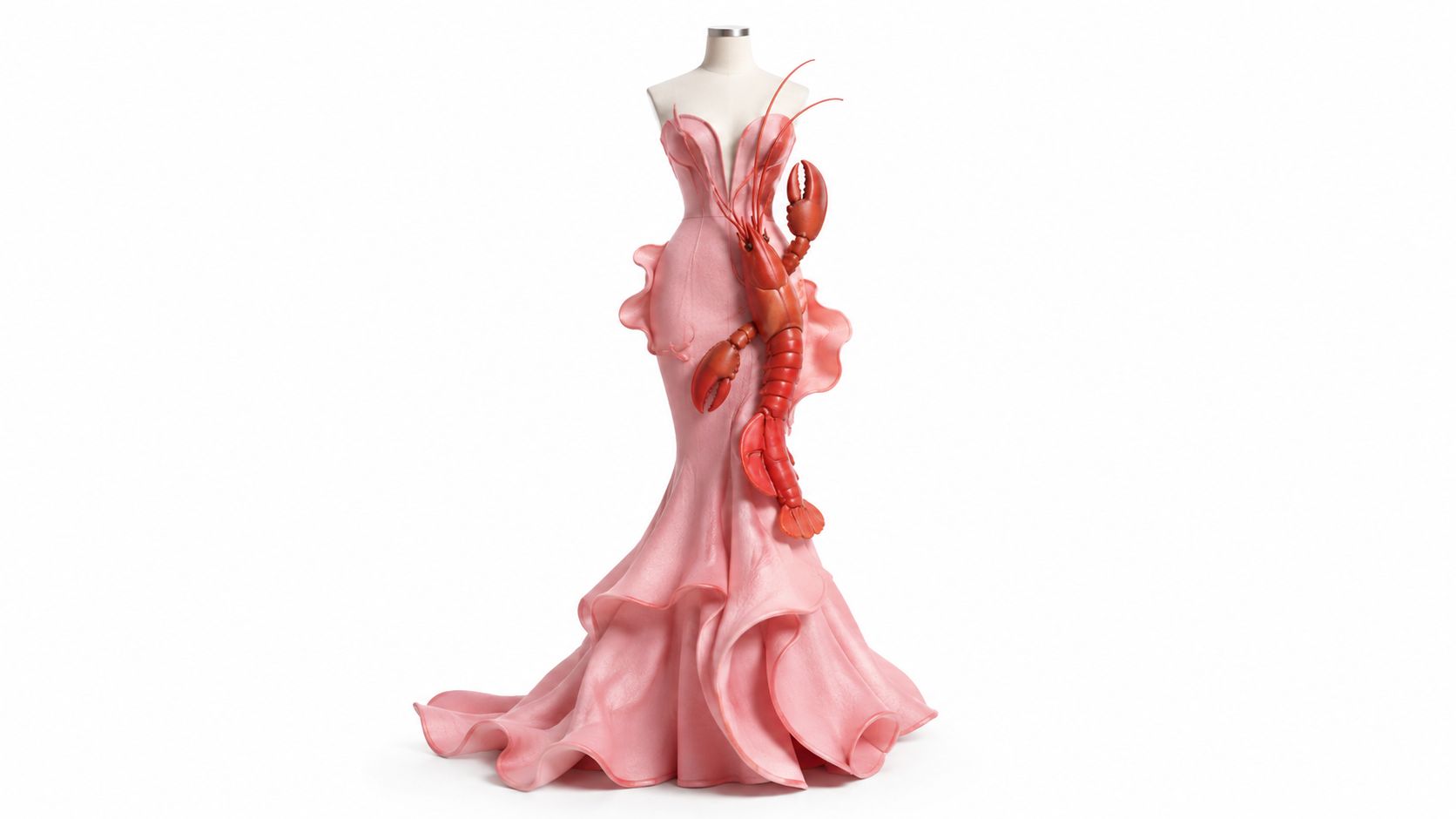
Daniel Roseberry's work at the house since 2019 kept those jokes on a current runway. On a product page, a second graphic kills the first.
- Hero plus quiet ground: Lobster dress or bow sweater, then black trousers or a plain coat.
- Print fidelity: Upload a high-resolution flat so the motif doesn't smear.
- One-line concept card: "Fake bow, real knit" stops the campaign team from inventing another story.
Cropping the lobster to fit a square is how you lose the product. If a claw disappears, you've shot a pink dress, not the joke.
4. Mary Quant and the Miniskirt
Mary Quant's Bazaar opened on King's Road in 1955 and sold clothes at Saturday speed, not couture speed. The miniskirt, hot pants, opaque tights, and hard prints made youth the customer. Vidal Sassoon's geometric bob finished the look above the collar. Ready-to-wear stopped waiting on a private fitting.
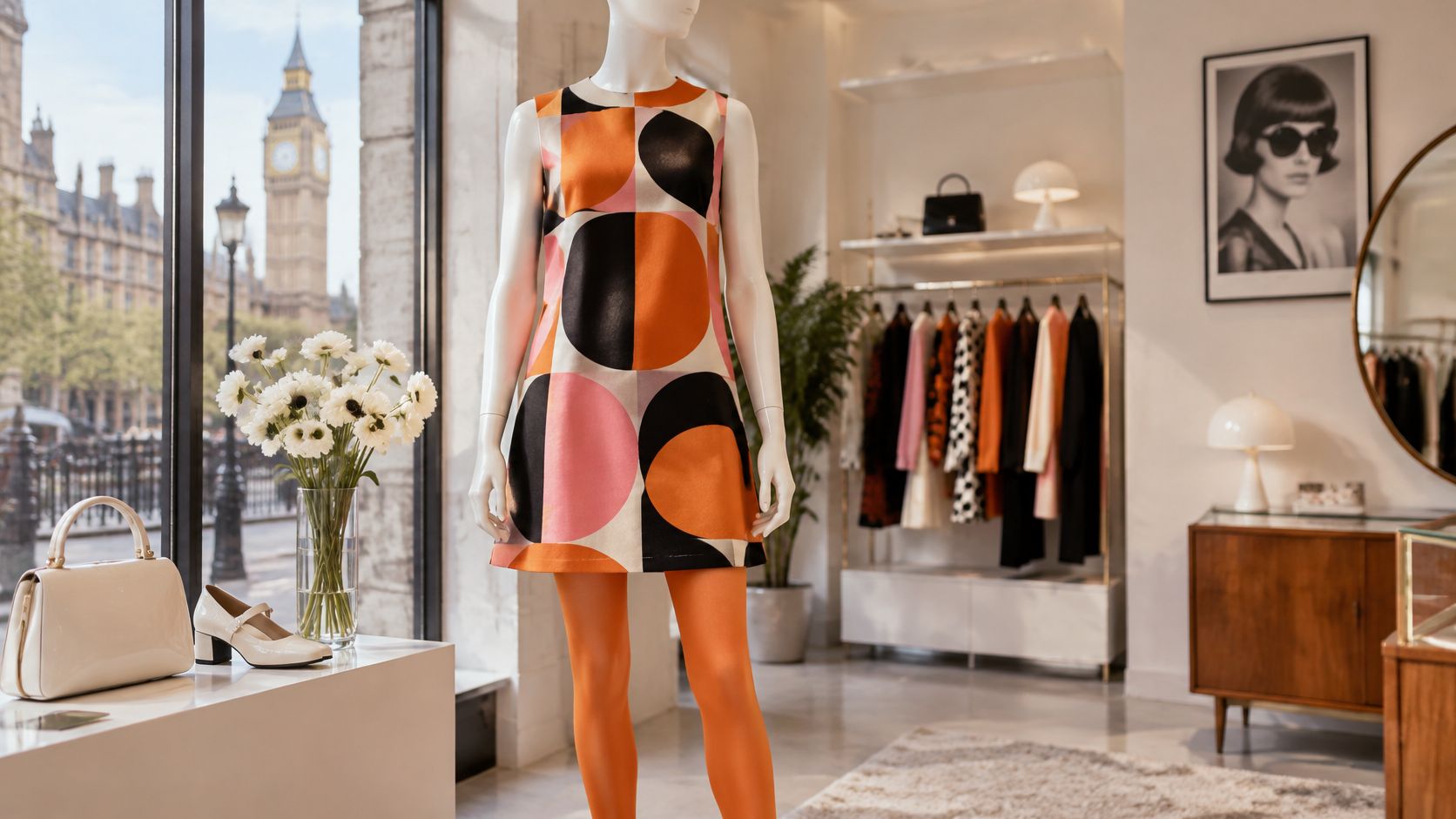
Length is the product
Shoppers argue about hems more than about prints. Put three lengths of the same shift in the library and keep tights and shoes in the same generation.
- Full mod kit: Shift, tights, boot or flat, and a bob-length note in the prompt.
- Refresh the print, keep the proportion: Trend pieces stale faster than tailoring.
- Same stance, three hems: Knee, mid-thigh, and shorter, so proportion is comparable.
A miniskirt shot only as a flat lay hides the one thing Quant sold, which is where the hem sits on a leg.
5. Vivienne Westwood and Punk Tailoring
Vivienne Westwood didn't sand punk into a logo and stop. With Malcolm McLaren she built Seditionaries on King's Road from ripped tartan and bondage trousers, clothes that looked unfinished on purpose. The 1981 Pirate collection swung romantic and swashbuckling. Later corsets and Harris tweed brought old making back, beside her line to buy less, choose well, and make it last. She was made a Dame in 2006.
Buy less only lands if the photo shows why the cloth survives a second winter.
- Construction in the caption: Tartan weight, stitch, corset boning. "Timeless" isn't a fact.
- One loud piece: Jacket or corset anchors. Tee and trouser stay plain.
- More than one torso: Structured jackets change shape by body. Test before the ad runs.
Five competing statements in one prompt fail her test. The rip or the tartan is the sentence. Everything else is grammar.
6. Diane von Furstenberg and the Wrap Dress
Diane von Furstenberg turned one wrap into a company. A wood-grain version appeared in 1973. The jersey dress followed in 1974, cloth crossing the body and tying at the waist. Encyclopaedia Britannica notes production near 25,000 dresses a week, millions sold by 1976, and a Newsweek cover that year describing her as the most marketable woman in fashion since Coco Chanel. The Los Angeles Times put sales above 5 million by 1978, with clothing and licenses at $60 million in retail by the end of 1976.
Scale had a cost. By 1978 the market looked oversaturated, and she left Seventh Avenue in 1979. She brought the dress back in 1997 after younger buyers hunted vintage copies. A signature can fund licenses, and it can drown in them.
Same dress, new print
Lock the model and the pose. Change only color and print, and say jersey, stretch, and tie placement the way a clear virtual try-on reference should.
- One size story: Use the wrap as the silhouette in the guide so shoppers compare prints, not mysteries.
- Don't restyle the tie: A knot in one frame and an open drape in the next is two products.
7. Donna Karan and Seven Easy Pieces
Donna Karan's Seven Easy Pieces, introduced in 1985, was wardrobe math. A bodysuit as the base, then a skirt, a jacket, and a few companions covering work, travel, and evening without a second closet. DKNY, from 1989, pushed that logic toward city prices people could rotate.
Five to seven garments is enough when they share a palette. Generate the combinations and note which piece appears most. That count is your reorder signal, not a mood board.
Build the matrix
- Shared model and background: A new set for every outfit kills the modular read.
- Keep the base constant: Change the jacket, not the person.
- Two lives per piece: A create-your-own outfit test should show each garment in at least two looks.
Seven statement jackets aren't a capsule. Karan's system needs a quiet foundation, or "easy" is only a headline.
8. Rei Kawakubo and Deconstruction
Rei Kawakubo founded Comme des Garçons in Tokyo in 1969 and showed in Paris in 1981, when a missing shoulder stopped being a mistake. Asymmetry and raw edges came first. The 1997 collection Body Meets Dress, Dress Meets Body went further, padding the garment until the body looked redesigned.
Where these clothes belong
Sculptural volume is a brand story, not the hero of a size chart. Park it in editorial. Leave core listings for pieces a shopper can imagine walking in.
- Several angles: A pad or a dropped shoulder lies in a single front photo.
- Several bodies: Padding reads differently by frame. Test before you promise a shape.
- One idea in the prompt: "Hip pad, neutral ground, full length in frame." Don't add a second concept.
Crop the pad out for a social square and you've photographed a different garment.
9. Stella McCartney and Sustainable Luxury
Stella McCartney launched her label in 2001 on a hard rule. No leather, no fur. Luxury had treated animal skin as the proof of a "real" bag or jacket. She put the alternative in the product, not in a footnote. A 2004 Adidas partnership carried that stance into clothes people sweat in.
Say the material, then show it
- Name the fiber: Recycled nylon or a plant-based alternative, whatever the spec sheet says. "Eco" isn't a fact.
- Match sheen to the swatch: Vegan surfaces don't catch light like calfskin. An overshiny render oversells the good.
- Keep the tailoring: A sharp shoulder proves the ethics didn't replace the cut.
Green lines without a material name train buyers to skip the next claim.
10. Miuccia Prada and Nylon Luxury
Miuccia Prada took a leather-goods house in the late 1970s and argued with its own idea of luxury. The 1984 black nylon backpack, cut from technical cloth, made hardware and nylon feel newer than another polished hide. Miu Miu, launched in 1993, gave the house a younger sibling. The collections still like a clash. Uniform beside ornament, sport beside salon.
Prompt the contrast
Group the library by story, not only by category, so the nylon bag can find a severe coat.
- Mood in one line: "Formal coat, casual nylon pack, cool light, no extra logos."
- Move the bag: Hand, shoulder, then back. A statement piece only changes the look if you can see it.
- Don't smooth the clash: Matching everything to the nylon deletes the Prada move.
If the backpack sits in the corner like an afterthought, you've shot a coat campaign and lost the product that remade the house.
10 Famous Women Designers: Signature Innovations Comparison
| Designer / Approach | 🔄 Implementation Complexity | ⚡ Resource Requirements | 📊 Expected Outcomes | ⭐ Ideal Use / Key Advantage |
|---|---|---|---|---|
| Coco Chanel, Little black dress and mix-and-match tailoring | Moderate; coordinate versatile separates | Core wardrobe pieces, tailored fabrics, consistent styling | Flexible outfits with high garment reuse | Capsule collections; timeless, easy-to-coordinate looks |
| Madeleine Vionnet, Bias cut | High; precise patterning and fabric handling | Fluid fabrics, careful draping, extra fabric allowance | Body-skimming garments with natural movement | Eveningwear and fit-focused imagery; expressive drape |
| Elsa Schiaparelli, Surrealism and trompe l'oeil | High; distinctive graphics need careful execution | Detailed prints, bold colors, high-resolution imagery | Memorable, art-led statement pieces | Campaigns and hero products; strong visual identity |
| Mary Quant, Miniskirt and mod fashion | Moderate; rapid trend and collection updates | Ready-to-wear production, coordinated accessories | Youthful, recognizable looks for seasonal launches | Trend-led retail; accessible, coordinated styling |
| Vivienne Westwood, Punk tailoring and sustainability | High; complex construction and strong styling direction | Skilled tailoring, durable materials, fit testing | Distinctive pieces with an emphasis on longevity | Statement collections; recognizable design and durability |
| Diane von Furstenberg, Wrap dress | Low to moderate; fit depends on wrap and fabric | Stretch jersey, accurate fit and drape information | Adaptable silhouette across prints and body shapes | Versatile ready-to-wear; easy styling and broad appeal |
| Donna Karan, Seven Easy Pieces | Moderate; pieces must coordinate consistently | Small, coordinated garment capsule and shared styling | Many outfits from a limited wardrobe | Capsule collections; efficient outfit building |
| Rei Kawakubo, Deconstruction and sculptural silhouettes | Very high; unconventional forms require testing | Detailed, multi-angle imagery and diverse fit testing | Experimental silhouettes and editorial impact | Editorial storytelling; challenges conventional ideas of shape |
| Stella McCartney, Sustainable luxury | Moderate to high; material behavior varies | Alternative materials, sourcing data, accurate texture imagery | Luxury products with clearly communicated material choices | Values-led collections; differentiation through sustainability |
| Miuccia Prada, Nylon and intellectual design | Moderate to high; concepts can complicate styling | Innovative materials, clear product grouping, directed styling | Distinctive products and concept-led campaigns | Editorial collections; material innovation and contrast-driven looks |
Try These Iconic Styles in Your Next Shoot
Pick one signature and stop there. Capsule layering, bias drape, a single bold print, or clean tailoring. Stacking a Chanel jacket, a Kawakubo pad, and a lobster in one frame makes a costume, not a product a buyer can reorder.
A usable prompt names the garment, the body, the light, and what you won't add. "Black dress, collarless jacket, chain-strap bag, same stance, three shoes" is a Chanel test. "Jersey wrap, tie visible, pose locked, print only changes" is a von Furstenberg test. Run those before you book a full crew. With Vtry AI you can combine a saved person with several garments, keep the results in the workspace, and publish the frames that still read at thumbnail size.
Who gets the credit is still uneven, and not only in fashion. A 2025 analysis cited by Envato found women were more than 60% of graphic-design graduates but only 5 to 11% of creative directors, and that only 0.1% of creative agencies were founded by women. The same discussion of designers who changed contemporary design notes Vogue Business data in which nine of 35 major luxury brands were women-led, while eight of the ten most size-inclusive Paris shows were too. Celebration after a hit isn't the same as holding the pencil.
Authorship has been stripped before. Aino Aalto's work was credited mainly to her husband, and Ray Eames was left out of the Museum of Modern Art's 1946 title, "New Furniture Designed by Charles Eames," a pattern historians of forgotten women in design still have to correct. Write the living designer's name into the asset. Don't let the prompt become the author.
Adoption follows the task, not the novelty. A 2025 study of 267 Chinese fashion designers, 195 of them women (73.03%), found usefulness, task fit, and self-efficacy lifted intention to use generated content, while intellectual-property worry wasn't significant in that model, according to the peer-reviewed adoption study. The sample is China-based and measures intention, not long-term use. Still, the studio lesson is plain. Keep the garment, the person, the edit, and the output in one place, and label what the designer authored versus what the tool varied.
For the shoot, choose the body on purpose. Size-inclusive leadership in those Paris shows wasn't an accident of casting. If your test images only fit one frame, you haven't learned the silhouette. You've learned the sample size.
Vtry AI is an AI fashion photo studio for building full outfits, not single-item overlays. Import garments, keep people and looks in one workspace, and test the signatures above, from a wrap dress to a nylon bag, before you spend a shoot day. Start with your own pieces at Vtry AI.