what do fashion stylists do
What Do Fashion Stylists Do Each Day
What do fashion stylists do before, during, and after a shoot, and how ecommerce teams turn those looks into consistent product imagery.
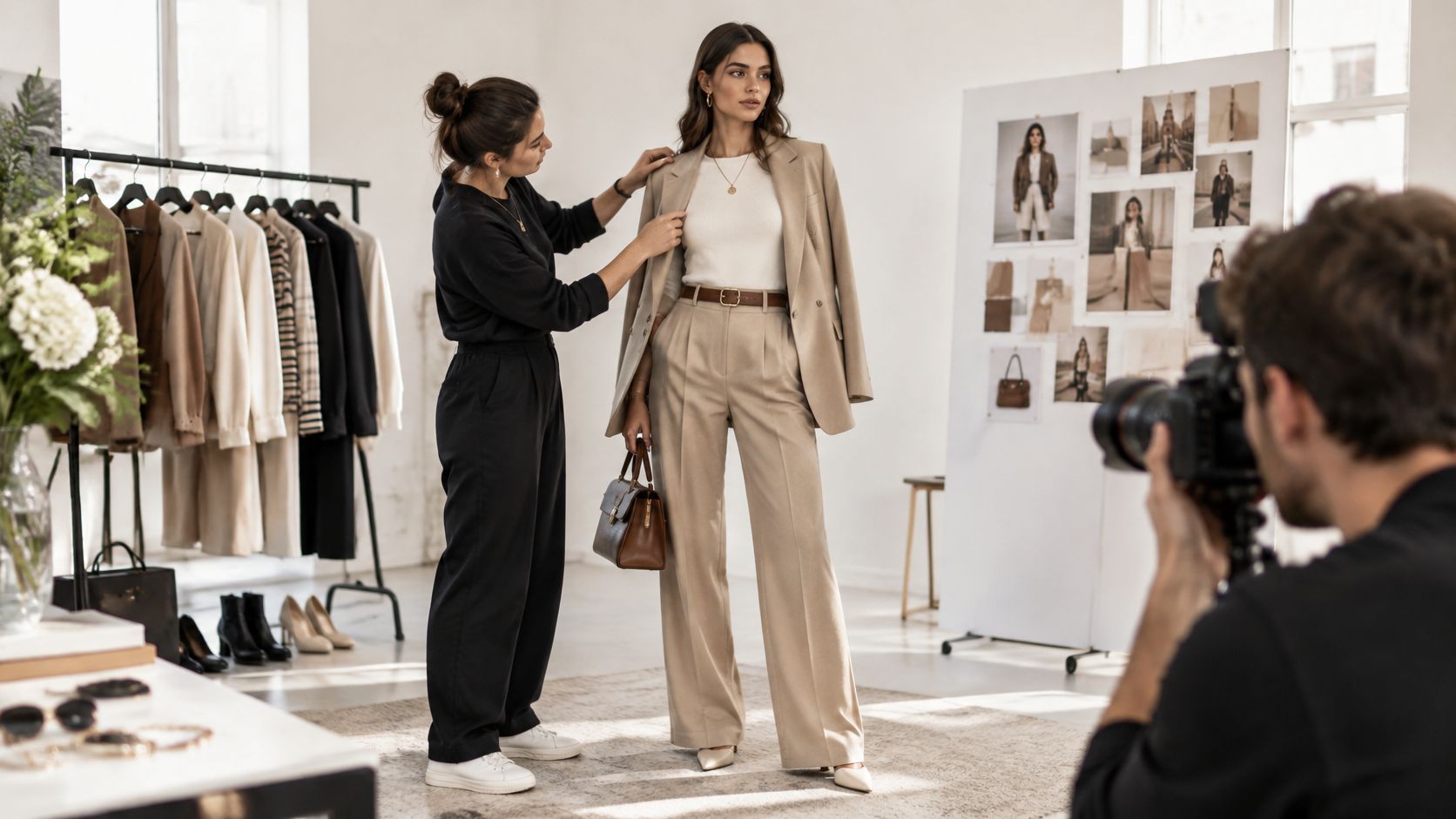
Fashion stylists curate and combine existing garments into a complete visual look for a person, story, or brand, rather than designing new clothes.
The popular advice says start with taste, follow trends, and build outfits you love. That's backwards on a paying job. Taste doesn't reserve the right size, survive a tight crop, or get a borrowed jacket back to a showroom on time. The outfit is the last visible step in a longer system of briefs, pull lists, fittings, returns, and look notes.
If you're learning what do fashion stylists do, watch the paperwork and the fitting, not just the final rack.
Table of Contents
- What Fashion Stylists Do on a Real Job
- How a Brief Becomes a Finished Look
- The Production Work Around the Shoot
- How Styling Makes Products Easier to Buy
- Four Jobs That Show the Same Method
- Myths That Shrink the Stylist Role
- Run Your Next Look Like a Stylist
What Fashion Stylists Do on a Real Job
A fashion stylist translates a concept, person, or brand identity into a complete visual look. Day to day, that means researching references, selecting garments and accessories, sourcing samples, arranging fittings, and coordinating designers, photographers, models, makeup artists, and clients.
That definition is broad because the settings are broad. You'll find stylists in editorial photography, advertising, ecommerce, celebrity dressing, film, television, retail, and personal styling. The deliverable changes, but the core decision stays similar. Which existing pieces, worn together, tell the right story for this audience?
The line between stylist and designer
Readers get confused most often. A fashion designer creates original clothing, chooses fabrics, develops prototypes, and oversees production. A stylist mainly curates and combines pieces that already exist.
A 2016 peer-reviewed study of the fashion stylist describes the stylist as a "cultural intermediary" between designer and consumer. In plain language, the stylist interprets garments and shapes how an audience understands them. She or he doesn't just display a coat. The pairing, fit, and setting tell you if that coat reads as office, luxury, street, or evening.
What each styling role delivers
| Role | Core decision | Works with | Finished output |
|---|---|---|---|
| Editorial stylist | Which pieces tell the story for a magazine or campaign | Photographer, designer, makeup, hair | A styled set with a clear silhouette and color story |
| Ecommerce or content stylist | Which products belong together on a page or ad | Merchandiser, photographer, content manager | A shoppable complete look that keeps the product recognizable |
| Celebrity or appearance stylist | What a person wears for an event, screen, or public appearance | Publicist, tailor, client | A fitted outfit that works in motion and on camera |
| Personal stylist | What stays, goes, and fills gaps in a client's wardrobe | Client, tailor, retailers | An edited closet, outfit plan, and shopping or tailoring list |
| Fashion designer, not a stylist | What new garment to create | Pattern makers, factories, buyers | An original product, not a curated combination of existing pieces |
A stylist's output isn't an outfit alone. It's an image system built from silhouette, color, accessories, setting, and presentation, all serving one communication goal.
That goal matters because every job carries commercial limits. A piece may be unavailable, off brand, late, or wrong for the deadline. Good styling balances artistic judgment with those limits instead of ignoring them.
How a Brief Becomes a Finished Look
Most looks fail before anyone touches a garment. They fail because the brief was vague. A stylist reads it for specific inputs, then turns those inputs into decisions a team can test.
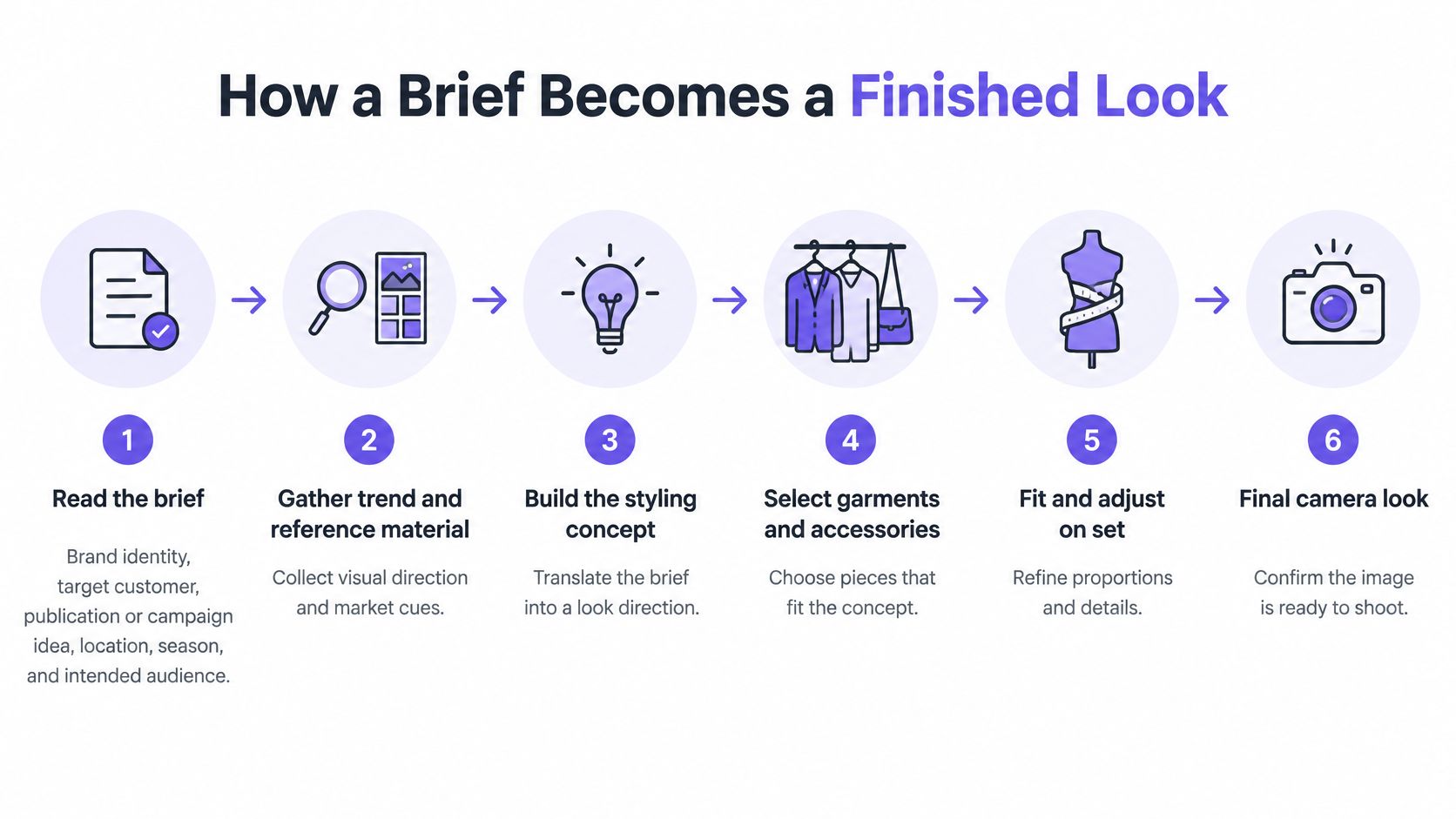
Five moves from brief to camera
- Read the brief. Name the brand identity, target customer, publication or campaign idea, location, season, and intended audience. If you can't name the customer and channel, you can't judge proportion or color yet.
- Gather references that support that brief. Trend and cultural references aren't a generic mood board. A reference earns its place if it clarifies silhouette, color story, setting, or how formal the look should feel.
- Source garments and accessories. Pull wearable sizes, not just ideal colors. Bring at least one backup for the hero piece, because a single sample can arrive damaged, late, or in the wrong size.
- Fit on a body. Judge color, proportion, texture, silhouette, and movement in person. A flat product shot won't tell you if a trouser twists at the knee or a knit pulls across the shoulder.
- Swap what the fitting disproves. Replace pieces before photography, not in post. Substitutions are part of the method, not a sign the first idea failed.
What a fitting actually catches
A fitting gives you evidence. Common failures include fabric distortion, poor layering, incompatible proportions, and insufficient visual contrast for the planned crop. A black top under a black jacket may look rich in the room and flat in a thumbnail. A long shirt under a cropped jacket may bunch every time the model sits.
The O*NET occupational profile for fashion designers lists comparable technical behaviors, including examining garments on and off models, modifying designs to achieve a desired effect, and organizing work against defined goals. The stylist's version is quality control between merchandise and final imagery. You're checking the combination, not redesigning the garment.
Practical rule: If a detail must sell the product, it must stay visible after styling, lighting, pose, and crop.
That check is called product truth. Color, construction, fit, and key details must stay recognizable while the outfit still serves camera angle, lighting, crop, and story. Roll a sleeve and you may hide the cuff detail a buyer needs to see. Add a belt and you may change where a dress is meant to sit at the waist.
For digital teams, the useful working file mirrors that fitting logic. Keep a multi-garment look with structured garment information, a person reference, and versioned notes for controlled substitutions. A folder of disconnected single-product images can't show you what changes when you swap the shoe, shorten the layer, or tighten the crop. The look file can, because it records the same variables a stylist manages on a body.
The Production Work Around the Shoot
Ask what do fashion stylists do before and after the shoot and you get the part taste-focused explainers skip. The camera time is short. The production around it isn't.
Before the shoot, the stylist turns a concept into a pull list. Every item needs a color, size, source, and backup. She confirms availability, arranges loans or purchases, schedules fittings, steams garments, tags options by look, and packs pieces so an assistant can find look three without unpacking the whole rack.
During changes, she logs what's worn, what failed on the body, and what the client or brand approved. That log matters when the photographer asks to return to an earlier combination two hours later. Without it, you're rebuilding from memory while studio time runs.
If you're new to set workflow, our guide to fashion photography for beginners covers how styling decisions interact with lighting and call time. On a real set, those decisions aren't separate conversations.
What each stage prevents
Stylist stages and what breaks if you skip them
| Stage | Main task | What fails if skipped |
|---|---|---|
| Brief | Turn brand, audience, season, and channel into a look direction | Imagery that misses the customer or the page |
| Pull list | Reserve colors, sizes, and at least one backup hero piece | Wrong size or an empty rack on set |
| Prep | Steam, tag, and pack the approved options | Wrinkled clothes or pieces nobody can identify |
| Fitting | Test proportion, layering, movement, and product truth | Problems caught only after the shoot is over |
| Shoot | Adjust for light, crop, pose, and last-minute swaps | Unusable frames and lost call time |
| Returns and archive | Log credits, send loans back, and save the look notes | Missing samples, surprise fees, and a look nobody can repeat |
An Indeed career guide to becoming a fashion stylist outlines the visible parts of the role, including assembling outfits, researching trends, sourcing garments, and collaborating with photographers, designers, makeup artists, and hairstylists. The invisible workflow sits underneath that list. Concept, pull list, availability checks, steaming, fittings, return tracking, and backup looks all have to happen under deadline and budget limits.
For ecommerce and creator teams, these steps control four practical risks:
- Image consistency: The same approved combination appears on the product page, email, and ad.
- Product availability: You don't build a hero look around a shoe that's out of stock.
- Production risk: A backup covers a late sample or a fitting failure.
- Reuse across channels: Saved notes let a second person rebuild the look for a new crop.
Styling is creative direction and operations management in the same job.
That's the working definition this production sequence earns. Remove the operations and the creative idea often never reaches the camera intact.
How Styling Makes Products Easier to Buy
Building a beautiful outfit and making a product easy to buy aren't the same skill. The second skill is commercial translation. The stylist turns creative direction into clothes that communicate market position and a purchasing use case.
A knit styled with fitted trousers and loafers says work. The same knit with denim and boots says weekend. Neither pairing is neutral. Each one tells a shopper where the product belongs and when she'd wear it.
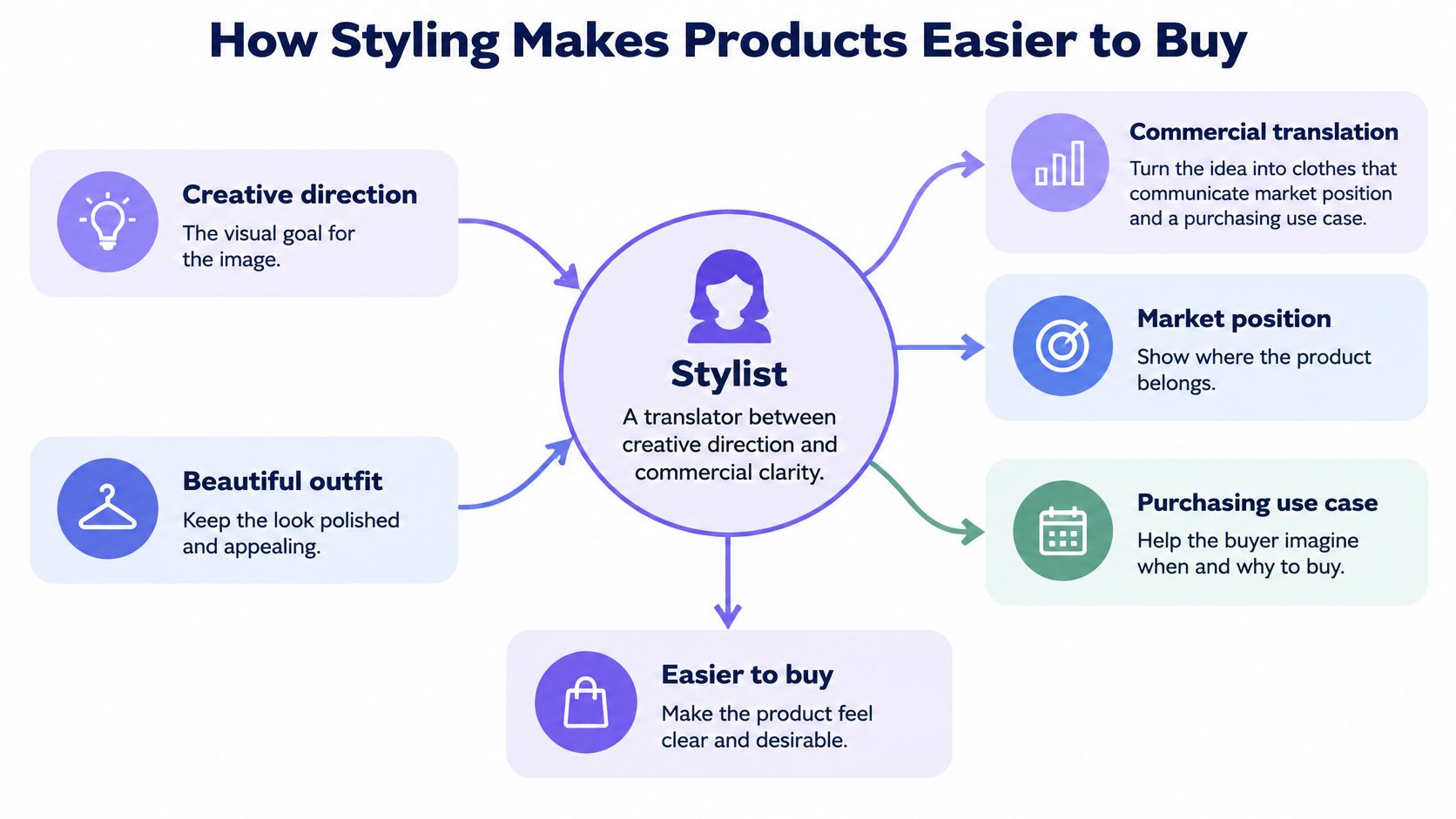
The handoff is a specification
That translation happens inside hard limits: availability, sizing, seasonality, budget, sample logistics, brand rules, and the number of deliverables needed for editorial, ecommerce, advertising, and social. The output is a reproducible visual specification, not just a finished outfit. It lists selected items, dressing order, accessories, fit decisions, references, and instructions for photography or post-production.
The University of Manchester publication record on fashion product development, buying, and merchandising describes the wider pipeline as an integrated process linking concept formation, product decisions, buying, merchandising, and retail execution. Styling fits inside that pipeline. It isn't an isolated creative act at the end. Visual merchandising works the same way in a store, where coordinated displays, color, layout, lighting, and product emphasis shape perception before a shopper reads a label.
Say a shopper lands on a trouser page. She sees the trouser with a tucked knit, a belt at the natural waist, and a shoe that shows the hem length. Silhouette, use context, and product relationships are legible in one glance. She can infer how the trouser fits her wardrobe before she reads price or copy. That inference is the commercial value of styling. Our breakdown of ecommerce model photography shows why that on-body context changes what a gallery can prove.
One look, three channel jobs
- Product gallery: Keep the garment fully visible, with construction and fit easy to inspect.
- Collection banner: Use a wider crop and stronger color story, because the job is range and mood.
- Vertical social frame: Show movement, such as walking or turning, so drape and length read quickly.
The specification must be clear enough for a photographer or merchandiser to execute without the stylist in the room. Narrative and brand judgment stay with the content lead, but the dressing order, visible details, and approved swaps should not live only in one person's memory.
Four Jobs That Show the Same Method
The settings look different from the outside. On the day, each one turns on a constraint and leaves notes someone else can follow.
The denim setup below shows the editorial version of that problem, where one jacket has to carry several combinations without losing its identity.
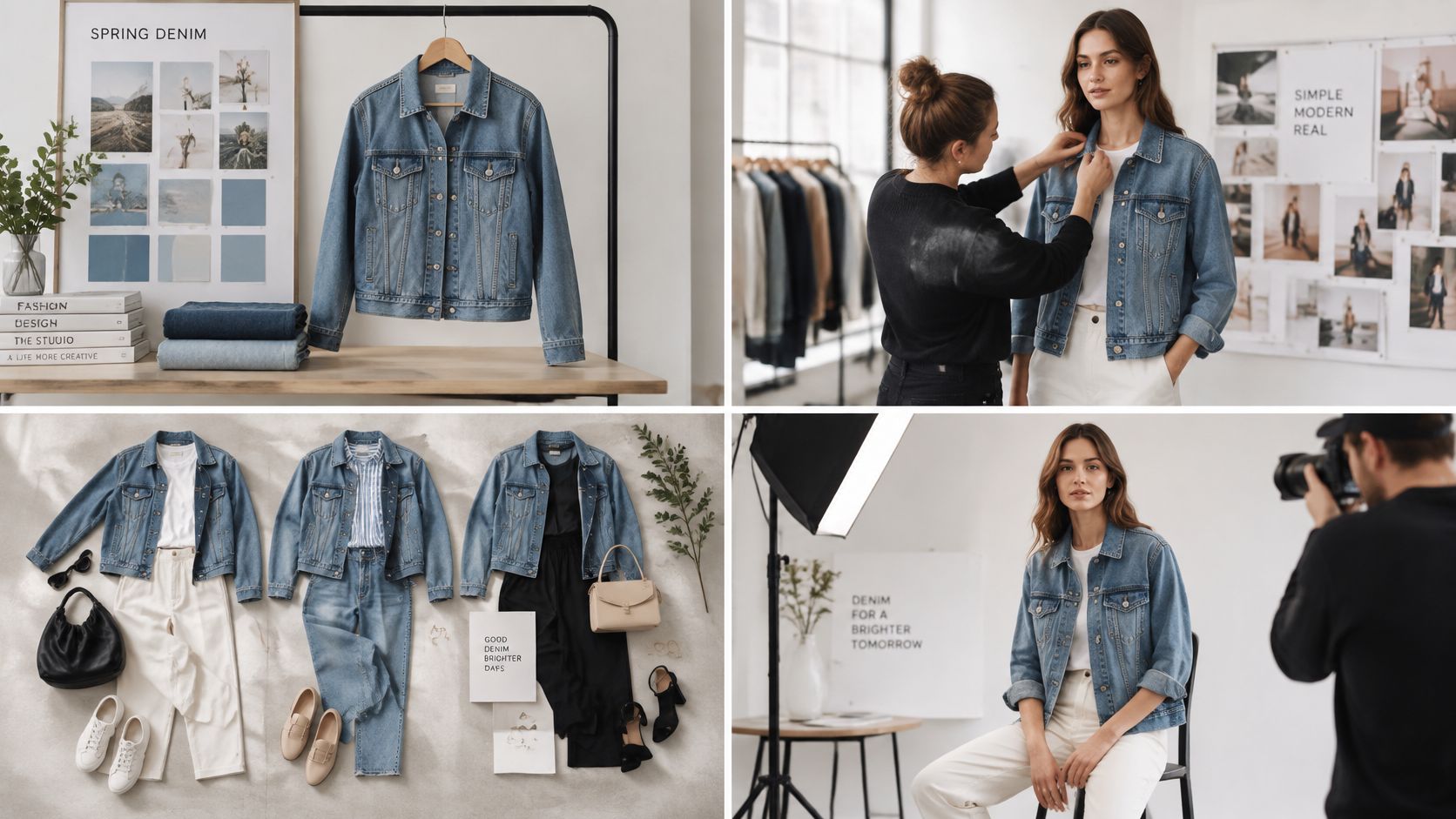
Editorial and ecommerce scenes
Say a spring denim story needs one hero jacket. The stylist pulls two backup washes and builds a color story that still reads if the printed page loses contrast. Print contrast decides the look. A pale wash against a pale shirt may disappear, so she adds a darker layer underneath and writes down which wash is approved for the cover crop.
Say a direct-to-consumer team sells a knit. Instead of showing only a flat packshot, the stylist pairs the knit with a trouser, belt, and shoe so the product page shows how it's worn. Product truth decides the look. When the merchandiser removes a sold-out shoe, the stylist swaps it, updates the combination, and saves the same notes for the email crop.
The video below gives a useful sense of how quickly those small on-set decisions accumulate into a finished frame.
Appearance and personal scenes
Say a client needs a premiere outfit. She'll climb stairs, stand under flash, and sit for interviews. The stylist chooses for movement under lights, books a short tailoring window, and packs a backup heel if the first pair wobbles or reflects badly on camera. The handoff is simple: outfit order, tape and pinning notes, and which backup replaces which piece.
Say a personal client books a long wardrobe session. The stylist starts with a closet audit, names the gaps against the client's actual week, and builds two work outfits from pieces she already owns. The session ends with a tailoring list and a short shopping list, not a trend haul. The constraint is her calendar, budget, and commute.
Every scene produces notes a second person could execute. That's what makes styling a system rather than a one-time opinion about clothes.
The people in the room matter when they change the decision. A photographer crops tighter, so a necklace moves. A tailor can't finish a hem, so the backup trouser wins. The method absorbs those changes because the brief, fitting evidence, and approved combination are written down.
Myths That Shrink the Stylist Role
Myth one: the job is choosing fashionable clothes. The visible outfit is the last step. A brief, pull list, availability check, and fitting come first.
Myth two: stylists and designers do the same career. Designers originate product. Stylists interpret existing product for a specific audience, body, page, or event.
Myth three: the work is mostly celebrity dressing. Retail, ecommerce, editorial, advertising, film, television, and private clients make up most of the field. Red carpets are the most photographed slice, not the whole job.
Myth four: you can judge stylists by a standard job title. The U.S. Bureau of Labor Statistics arts and design overview does not maintain a separate occupational category for fashion stylists. Many stylists work as freelancers or project-based contractors, so their work spreads across commercial shoots, retail campaigns, media productions, and private clients. Judge them by portfolio, repeat clients, and whether their looks hold up under production limits.
Myth five: the styling fee covers every cost. Shipping, tailoring, and purchased pieces are often billed apart from the fee. Ask for an itemized estimate before the pull starts, including who pays for returns and rush alterations.
Judge the work by the specification it leaves behind. A pull list, fit notes, credit log, and look record tell you more than taste alone.
Run Your Next Look Like a Stylist
Copy the method on your next collection, even if your team doesn't employ a full-time stylist.
- Write a one-page brief. Name the customer, channel, crop, and product details that must stay recognizable.
- Lock the inputs. Fix the person reference and garment list, including shoes and accessories, before you generate or shoot options.
- Test one substitution. Try the full outfit and one deliberate swap before you book more production time.
- Review against the product. Check color, construction, fit, and key details at full size, not only as a thumbnail.
- Export and archive. Save the approved look in the crops each channel uses, and keep the combination for the next drop.
Our guide to how to create your own outfit walks through building combinations piece by piece. A shared workspace makes that archive easier to keep. We store uploaded people, garments, and generated results in your workspace so a later shoot can reuse them instead of starting the pull again.
Our try-on path follows the same order: add a person from up to three photos or a camera capture, add clothes from a product URL or in-app search, then generate an outfit wearing up to seven garments. You can combine tops, jackets, pants, dresses, shoes, and accessories rather than overlaying a single item.
That shortens repeat sourcing and fitting tests. It doesn't choose the story, protect product truth, or replace a stylist's judgment. Run one reviewed look first, check it against the actual garment, then scale the rest of the shoot.
Build your next look the way a stylist runs a job, with the person, garments, approved combination, and channel crops saved in one place. Vtry AI lets you combine up to seven garments into a complete outfit and reuse people and results from your workspace for later shoots. Start with one reviewed look at Vtry AI before you scale the full collection.